
Ball gown dry cleaning at Luxe works layer by layer. We clean each layer on its own, treat the hems by hand first and finish the gown on a form, so allow two to three weeks. Right now, the gown probably hangs on a bedroom door: six metres of tulle, a horsehair hem that has crossed a lawn and a dance floor, and a bodice that held its shape for fourteen hours. We collect it from your door, so book a collection within days of the wedding, while the marks are still at their most willing to lift.
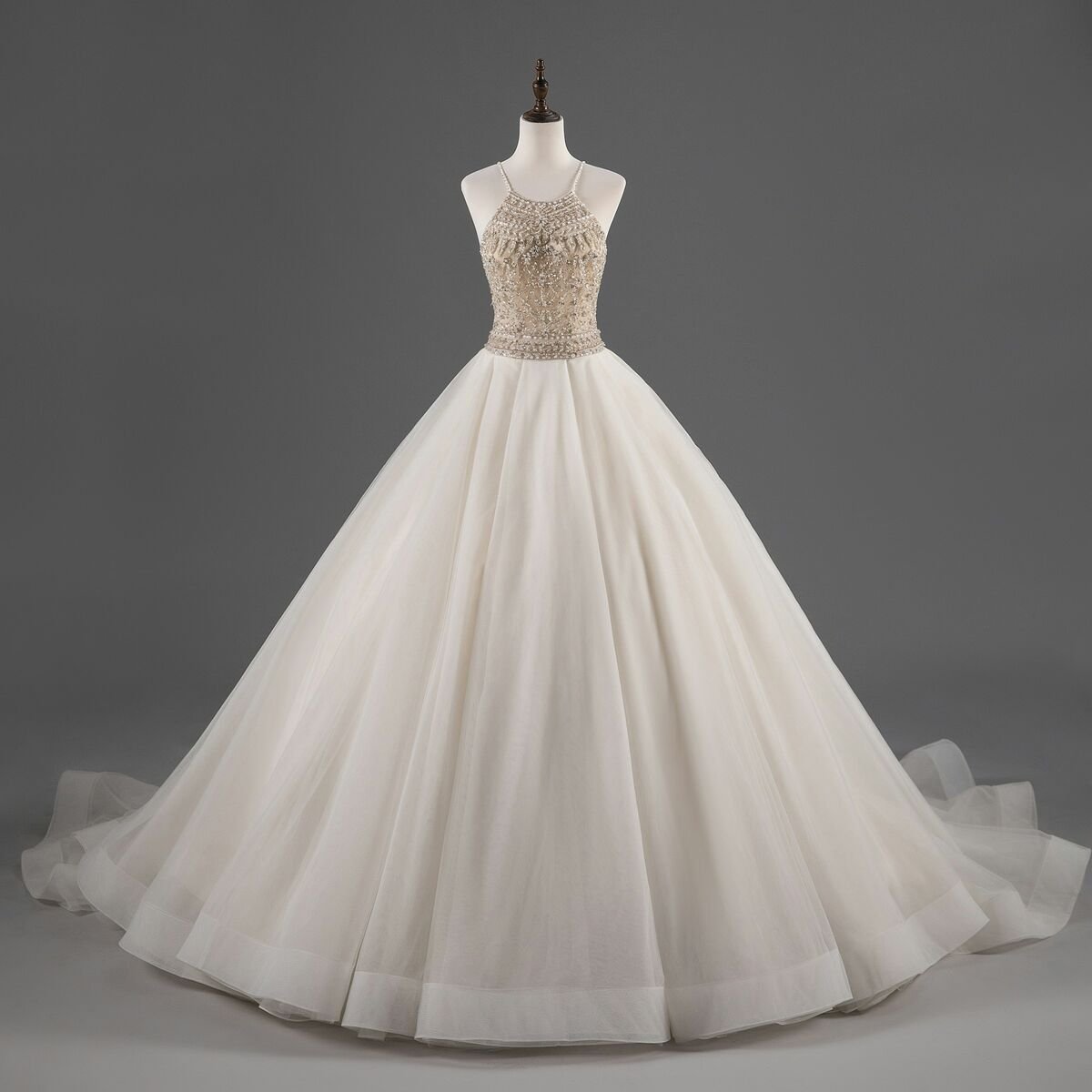
A full-skirted gown picks up a wedding’s worth of soil along its hem in a single evening. Book a collection for the week after the day and we collect it in a protective garment bag.
What is inside a full-skirted gown
A ball gown is less a dress than a small piece of architecture. Under the top layer of tulle or organza there are usually four to eight more. Each gathers onto a waist seam that carries the entire weight of the skirt. The hem often carries horsehair braid, a stiff mesh that holds the edge out in a clean curve. Below everything sits a crinoline or petticoat, sometimes with a hoop. Above the waist, a boned bodice holds in rather than out. It has a corset back or hidden zip, and often a layer of beading sewn or glued over the lot.
Each part responds differently to cleaning. Tulle snags on anything. Horsehair braid holds soil in its mesh. Boning channels trap moisture. Glued embellishment softens in the wrong solvent. Our guide to why bridal fabrics are the most complex to clean covers the fibres one by one. This post is about what happens when you stack them into one very large garment.
Where a ball gown picks up its marks
Nearly all the marks on a full-skirted gown are at the bottom. The hem has crossed a church floor, a lawn, gravel, a reception carpet and the dance floor. So it collects a band of soil along the lowest twenty centimetres of every layer.
- Hem soil. A grey or brown band through every layer, heaviest on the inner layers that touched the ground when the outer ones lifted.
- Grass and garden. Green staining on tulle and organza, usually at the back of the skirt and train where the gown lay on the lawn for photographs.
- Dance-floor scuffs. Black marks from polished timber and other people’s heels. They usually lift well if we treat them before they grind in.
- Spills, makeup and perspiration. Clear spills dry invisible and oxidise to brown over the following weeks. Makeup, tan and perspiration gather at the neckline and under the arms.
Our note on the post-wedding stains brides often miss explains why the clear ones do most harm.
Why volume changes ball gown dry cleaning
A standard dress goes through a cycle, then onto a press and a hanger. A ball gown cannot share a bag or a load with anything else. Many metres of tulle would tangle, tear or crush under their own weight in a conventional load. So we approach ball gown dry cleaning as a set of problems rather than a single garment.
- Each layer cleaned on its own. We separate outer tulle, inner tulle, lining and petticoat as far as the construction allows, without unpicking any seams, and clean each to its own fibre and fragility.
- Hems hand-treated first. We work the soiled band at the bottom of each layer by hand before anything else, so soil lifts rather than spreads through the skirt.
- The bodice protected. We test beading and embroidery, then wrap or net them so they cannot abrade the tulle or each other. We also check that no bone is close to cutting through its channel, and tell you if one is, since repairs are not part of our service.
- Shaped, not pressed flat. We finish the gown on a bridal form and dress the skirt layer by layer, aiming for the fall it had on the day.
A ball gown follows the same wedding dress cleaning process as every gown; it simply takes longer at each step.
How collection works, door to door
You book a collection online or by phone. Then we come to your home, your hotel or the venue, wherever the day ended. The gown travels in a protective garment bag, held so the skirt is supported rather than folded over on itself.
At our facility we assess it by hand under colour-correct lighting: every layer, every hem, the bodice, the closures and the trims. We price the work after that inspection, note anything unlikely to lift fully, and agree it with you before work begins. Allow two to three weeks for cleaning. If you would like the gown boxed afterwards, preservation adds about one more week. It comes back to your door in a garment bag or an acid-free box.
When to book, and what to do before the honeymoon
Book within days of the wedding. Fresh marks usually lift. Marks that have had a month to oxidise do not lift so readily. Hem soil also works deeper into the horsehair each time the gown moves. The ideal is a collection in the week after the day, while the champagne is still champagne and not a brown tide line.
If you are leaving for a honeymoon, book before you go and nominate someone, a parent or your building’s concierge, to hand the gown over. Until then, keep it out of plastic and hang it by the loops inside the bodice rather than the shoulders. Above all, do not dab at a mark with water. The Smithsonian’s textile conservators warn that even a glass of water can disfigure a textile. On tulle it leaves a ring harder to lift than the stain.
Your Questions, Answered
How long does ball gown dry cleaning take in Sydney?
Allow two to three weeks, because every layer and every hem gets its own attention. We do not rush it; if you need it sooner, ask at booking and we confirm at inspection. Preservation boxing adds about one more week, and we confirm the exact timing with the price.
Can you clean a gown with a very long train and a hoop petticoat?
Yes. Trains and petticoats are the most heavily soiled parts of a ball gown, so we treat them as their own pieces within the process. If the petticoat has hoops, tell us when you book so we can assess it with the gown. Hem soil usually improves markedly; where it may not lift fully, we say so at inspection.
Can I book the collection before I leave on my honeymoon?
Yes, and we encourage it. Book the collection for the days after the wedding and tell us who will hand the gown over. We inspect the gown and agree the price with you by phone or email before any work begins, so nothing proceeds without your agreement while you are away.
How is ball gown dry cleaning priced?
We price every gown after hand inspection and agree it with you before we start. Fabric, layers, embellishment and the condition of the hem vary too much from one gown to the next for a list price. Pickup and delivery is $25 flat. Our guide to wedding dress cleaning cost explains what moves the figure.
For ball gown dry cleaning, Luxe collects wedding and bridal gowns from Mosman, Double Bay, Vaucluse, Paddington and across Sydney in a protective garment bag, and returns them cleaned, shaped and ready to keep. Book online or call 0485 511 744. Pickup and delivery, $25 flat.