Colour bleeding and water marks are among the most destructive failures in luxury garment care. Unlike surface stains, these issues permanently change how dye sits within fabric fibres. Once they occur, few remedies exist, and in many cases the damage is permanent. For this reason, the safest approach is to prevent colour bleeding before any cleaning begins.
Why Luxury Garments Are More Vulnerable to Colour Damage
For high-value wardrobes in Sydney, the ability to prevent colour bleeding is not a matter of convenience; it is essential to protecting financial value, visual balance, and garment longevity. Achieving this level of protection requires specialist testing and risk assessment, as well as process control. Standard dry cleaners, however, rarely build their systems around these steps.
Because luxury fashion prioritises depth of colour, texture, and individuality, designers often rely on dyeing and finishing techniques that sacrifice durability for visual impact.
High-end garments commonly use:
These characteristics create richer tones and subtle shading, but they also reduce resistance to moisture, solvents, and heat. What appears stable during wear can become unstable during cleaning, making specialist control essential.
How Colour Bleeding Occurs and How to Prevent It
Colour bleeding happens when dye molecules loosen and migrate within or between fibres. Once mobilised, pigments move into surrounding areas, causing blurred edges, tonal shifts, and loss of contrast.
Bleeding is generally triggered by:
In many cases, bleeding begins invisibly and only becomes apparent when the garment dries. Even minimal migration can be visually catastrophic, especially on luxury garments with complex colour placement.
Water Marks Are Structural Damage — Not Surface Stains
Many people still mistake water marks for residue or spotting. In reality, they represent structural changes in dye distribution.
When moisture contacts fabric unevenly:
Water marks typically appear as:
Once they set, these distortions are extremely difficult to correct. In fact, attempting to “clean” them often worsens the imbalance.
Why Standard Cleaners Create High-Risk Conditions
Volume-based dry cleaners build their operations around speed and uniformity. Their systems assume garments within the same category behave similarly.
As a result, they typically do not:
A silk blouse, for example, may receive the same treatment as a mass-market polyester top, a practice that leads directly to bleeding and water marking in luxury garments.
Pre-Cleaning Testing: The First Step to Prevent Colour Bleeding
Specialist garment care begins before anyone applies a cleaning solution.
First, luxury professionals conduct targeted tests to evaluate:
These tests take place on concealed seams, hems or inner panels. The results then show whether a garment can safely go through cleaning and which method carries the lowest risk. If a test reveals instability, we may recommend partial or deferred treatment instead.
Precision Moisture Control to Prevent Colour Bleeding
Since moisture is the primary driver of both bleeding and water marks, specialists treat water and solvents as high-risk tools, not default solutions.
Professional protocols include:
Rather than saturating garments, specialists apply only the minimum required volume and distribute it evenly. They also match solvent chemistry to dye and fibre behaviour.
A piece worth protecting deserves a specialist.
Our Sydney couture and designer team handle it end-to-end — inspection, individual cleaning, hand-finishing, and door-to-door delivery.
Managing Layered and Composite Garments
Many luxury garments also contain multiple interacting layers, such as:
Each layer absorbs and releases moisture differently, so specialists often treat layers independently. They may also use isolation barriers and staged cleaning to prevent internal contamination and bleed-through.
Drying and Finishing Without Locking in Damage
Drying is also a critical risk phase, because rapid evaporation concentrates dyes and increases migration pressure.
To control this, luxury specialists carefully manage:
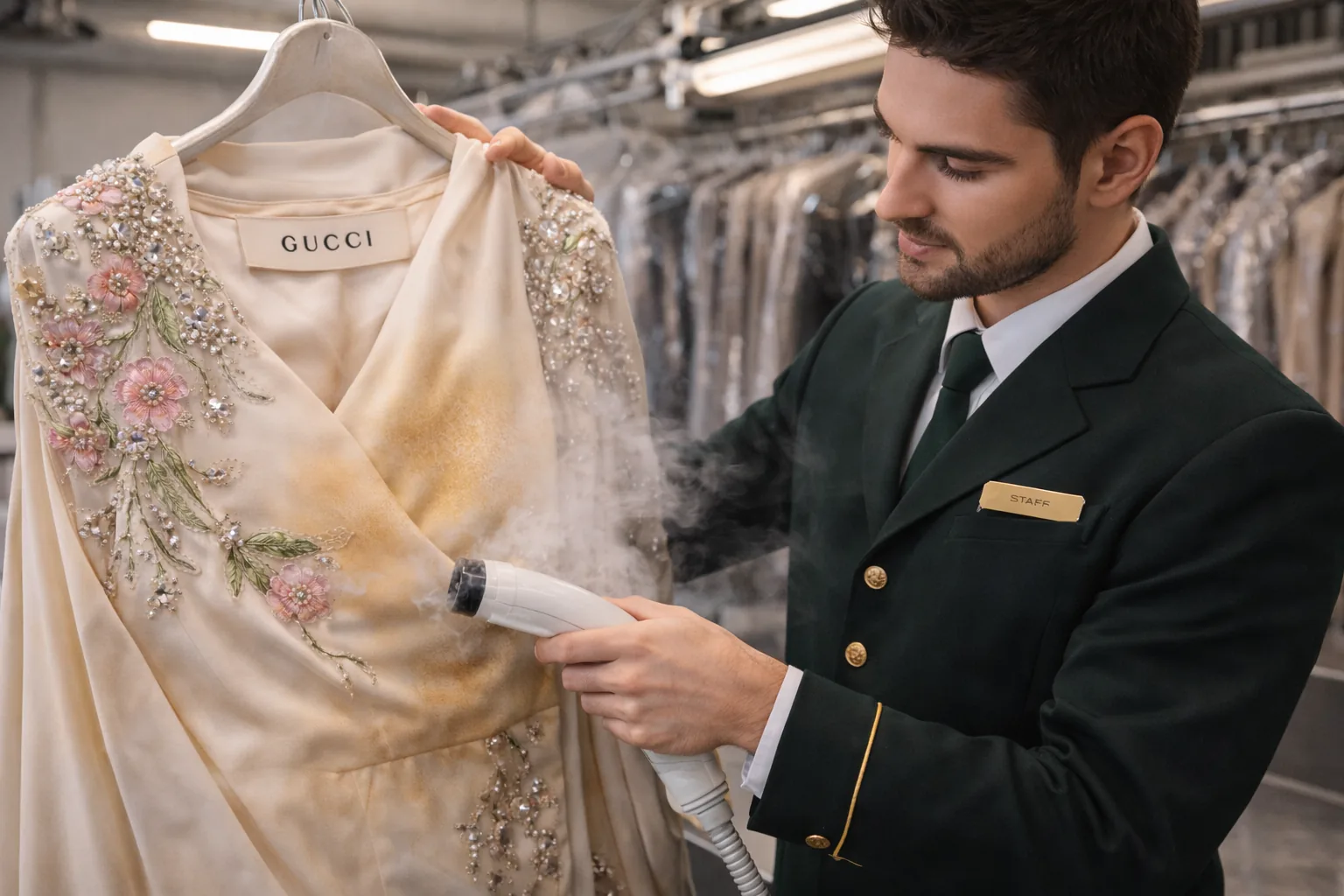
We often rest garments between stages so internal moisture can equalise naturally. Finishing comes last, once the garment has fully stabilised. We then use controlled steam zones and low-temperature tools to avoid reactivating unstable dyes.
The Role of Experience and Professional Judgement
Beyond technical systems, prevention also relies on experience. Specialist cleaners recognise early warning signs such as:
When these indicators appear, we intervene immediately, which automated systems cannot do.
How Luxe Dry Cleaners Works to Prevent Colour Bleeding
At Luxe Dry Cleaners Sydney, we treat every garment as a unique risk profile.
Each piece undergoes:
We never process a garment automatically, because the aim is to prevent colour bleeding rather than correct it. This methodology prioritises long-term preservation, so garments retain their original tone, clarity, and visual balance.
Book Your Pickup
Luxury Dry Cleaning, Collected From Your Door
Pickup and delivery for a flat $25 across Sydney CBD, the Eastern Suburbs (Double Bay, Woollahra, Paddington, Bondi, Bellevue Hill, Darling Point) and the Lower North Shore (Mosman, Neutral Bay, Cremorne, Kirribilli). Every piece inspected and hand-finished by specialists.
Prefer to talk first? Speak with a specialist ›
Frequently Asked Questions
Rarely. Most cases are permanent, which is why prevention is critical.
Higher pigment concentration increases dye instability.
No. Any uneven moisture distribution can create them.
Yes, when applied without proper control.
Different dye chemistries interact during cleaning.
No. Safety depends on fibre type and dye compatibility.
Specialist luxury garment professionals only.
Luxe Dry Cleaners is Sydney’s couture and luxury garment care specialist, servicing the CBD, Eastern Suburbs, and Lower North Shore. We also offer door-to-door pickup and delivery for a flat $25, with every piece hand-finished. Further reading on fabric care: Woolmark care guidelines.