Fur and shearling garments represent some of the most technically complex and valuable pieces in any luxury wardrobe. Unlike conventional textiles, these materials combine processed skin with natural fibres, creating a dual structure that demands highly specialised care.
The Dual-Nature Structure of Fur and Shearling
For high-net-worth clients, stylists, and personal assistants in Sydney, understanding why fur and shearling require specialist conditioning rather than standard cleaning is essential. Without expert handling, these garments can deteriorate rapidly — often beyond repair. In luxury garment care, preservation is not about appearance alone; it is about maintaining biological and structural balance.
Fur and shearling garments differ fundamentally from fabric-based clothing because they contain both hide and fibre.
Shearling consists of:
Fur garments feature:
Each side responds differently to moisture, temperature, and chemical exposure. Leather requires carefully controlled oil and moisture balance to remain supple, while fibres require gentle handling and stable humidity to preserve softness and alignment.
Treating these garments as single-surface textiles ignores this complexity and leads to internal imbalance, which standardised cleaning processes cannot accommodate.
Why Conditioning Is Essential, Not Optional
During any cleaning process, natural oils embedded in the hide are reduced. These oils are critical for flexibility, durability, and resistance to environmental stress.
Without proper conditioning:
Once internal oils are depleted, full recovery is rarely possible. Specialist conditioning restores essential lipids in controlled quantities, preventing oversaturation while maintaining elasticity. In luxury garment care, conditioning is a core preservation step, not an add-on.
Moisture Balance and Fibre Stability
Fur and shearling are extremely sensitive to moisture fluctuations.
Excess moisture causes:
Insufficient moisture leads to:
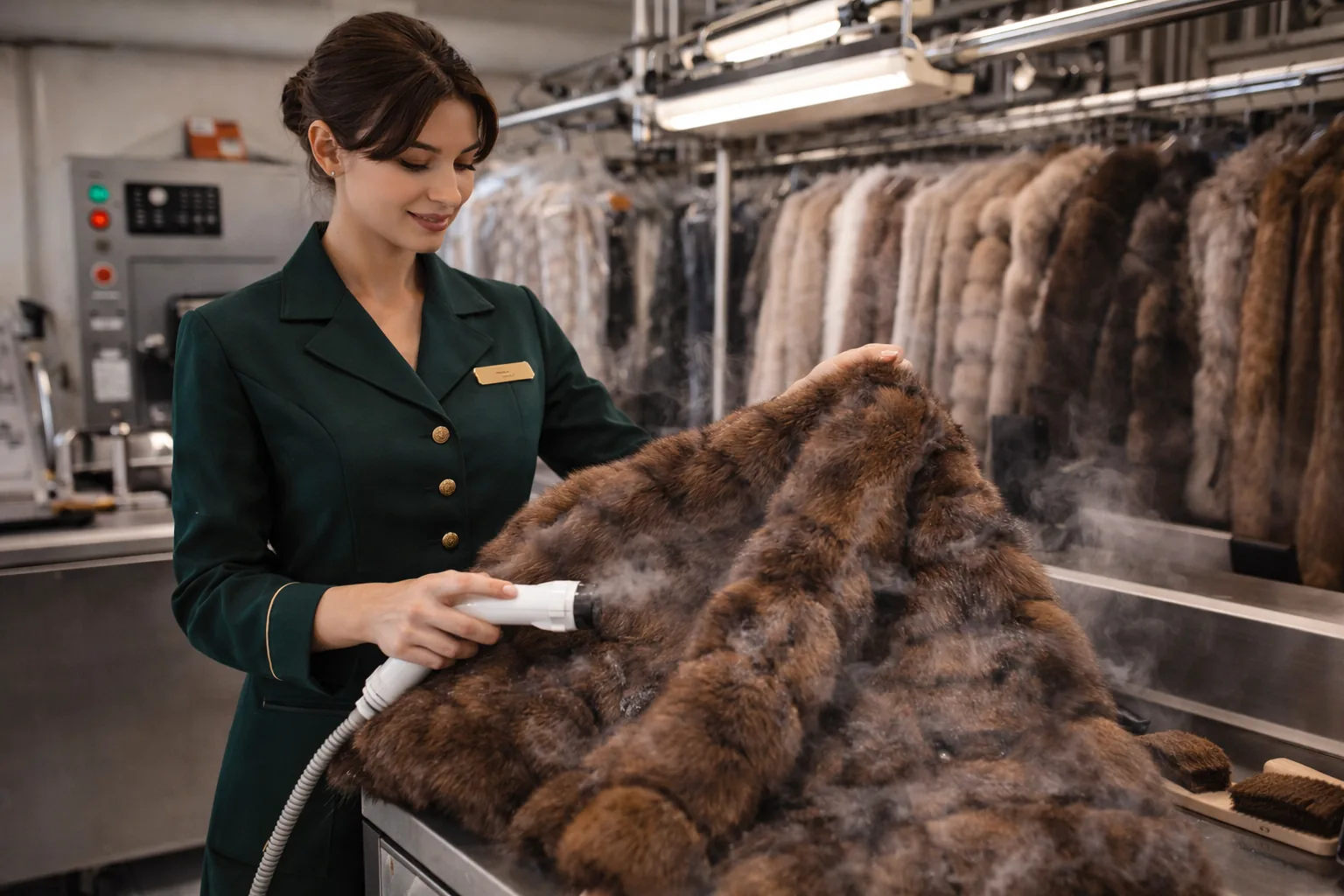
Specialist facilities regulate humidity throughout assessment, cleaning, drying, and resting stages to keep hides and fibres in equilibrium. Uncontrolled environments — common in standard cleaning operations — destabilise this balance and accelerate deterioration.
Temperature Sensitivity and Heat Damage
Heat is one of the most destructive forces in fur and shearling care. Even moderate temperatures can permanently alter structure.
Heat exposure results in:
Many luxury garments are damaged during rushed drying or improper storage near heaters or sunlight. Specialists rely on low-temperature, slow-drying systems and climate-regulated chambers designed specifically for natural skins.
The Importance of Resting and Recovery Periods
Unlike textiles, fur and shearling garments require recovery time after treatment.
Resting periods allow:
Skipping this stage leaves garments vulnerable to stiffness, uneven wear, and premature ageing. Luxury garment care incorporates controlled resting as a non-negotiable preservation step.
Grooming and Fibre Realignment
After cleaning and conditioning, fur fibres must be carefully realigned.
Professional grooming:
This work is performed manually using specialised tools. Mechanical grooming systems damage fibres and create long-term weakness. Proper grooming contributes to both visual refinement and structural integrity.
A piece worth protecting deserves a specialist.
Our Sydney couture and designer team handle it end-to-end — inspection, individual cleaning, hand-finishing, and door-to-door delivery.
Why Standard Cleaners Cause Irreversible Damage
Most conventional dry cleaners are not equipped to handle fur and shearling safely. They typically lack:
As a result, garments often appear superficially clean but are structurally compromised. Damage frequently emerges months later as cracking, matting, shedding, or odour retention — at which point restoration options are limited.
Storage as Part of Professional Fur Care
Cleaning is only one component of fur preservation. Storage plays an equally critical role.
Specialists advise on:
Improper storage accelerates deterioration even after professional treatment. Luxury care extends beyond the cleaning process itself.
Risk Management in Luxury Fur Care
Luxury fur care operates on a risk-management model. Every stage — inspection, testing, cleaning, conditioning, drying, resting, grooming, and storage — is designed to minimise irreversible outcomes.
Risk profiling identifies vulnerable areas, previous damage, and construction weaknesses before treatment begins. This disciplined approach separates preservation specialists from volume-based cleaners.
The Luxe Dry Cleaners Conditioning Philosophy
At Luxe Dry Cleaners Sydney, fur and shearling garments are treated as living materials, not static products.
Each piece undergoes:
Our process includes controlled cleaning, deep conditioning, slow drying, structured resting, manual grooming, and protective finishing. Garments are never rushed — preservation always takes priority over speed.
Book Your Pickup
Luxury Dry Cleaning, Collected From Your Door
Complimentary collection and delivery across Sydney CBD, the Eastern Suburbs (Double Bay, Woollahra, Paddington, Bondi, Bellevue Hill, Darling Point) and the Lower North Shore (Mosman, Neutral Bay, Cremorne, Kirribilli). Every piece inspected and hand-finished by specialists.
Prefer to talk first? Speak with a specialist ›
Frequently Asked Questions
Only using specialist fur-safe systems combined with professional conditioning.
Loss of natural oils and moisture imbalance within the hide.
Sometimes partially, but prevention is far more effective than restoration.
No. Traditional textile washing methods permanently damage fur.
Oil depletion and improper drying or grooming techniques.
Yes. Proper storage is essential for long-term preservation.
Specialist luxury fur and shearling professionals only.
Luxe Dry Cleaners is Sydney’s couture and luxury garment care specialist, servicing the CBD, Eastern Suburbs, and Lower North Shore with complimentary door-to-door collection and hand-finished quality. Further reading on fabric care: Woolmark care guidelines.