Linen is often misunderstood as a simple, durable, and low-maintenance fabric. Associated with relaxed summer dressing and effortless elegance, it is frequently treated casually in garment care. In luxury wardrobes, however, linen is one of the most unforgiving fabrics when handled incorrectly.
Linen’s Natural Instability
Fine linen garments used in tailored jackets, summer suiting, designer trousers, and premium shirts present a surprisingly high level of risk. For high-net-worth clients, stylists, and personal assistants in Sydney, understanding why linen requires specialist care is essential to preserving appearance, structure, and long-term value.
Linen fibres are derived from the flax plant and are characterised by low elasticity and high rigidity. Unlike wool or cotton, linen does not stretch and rebound easily. Once fibres shift or distort, they tend to remain permanently out of alignment.
This lack of elasticity explains why linen:
During standard cleaning processes, linen is exposed to movement and moisture that cause fibres to migrate within the weave. The result is often embedded distortion rather than temporary wrinkling.
Moisture Sensitivity and Fibre Movement
Although linen is breathable and absorbent, it reacts poorly to uncontrolled moisture. When fibres absorb water, they swell and shift. Combined with agitation, this leads to permanent deformation.
Common outcomes include:
Once these changes occur, reshaping is difficult and often incomplete. Luxury garment care therefore limits moisture exposure and tightly controls drying tension to prevent fibre migration.
Dye Absorption and Water Marking
Luxury linen is frequently dyed using natural, botanical, or low-impact colouring methods. These dyes penetrate fibres unevenly and remain highly reactive to moisture.
As a result, linen is notoriously prone to:
These issues are especially visible on light shades such as ivory, beige, pastels, and pale greys. Once established, water marks are extremely difficult to correct — making prevention far more reliable than restoration.
Structure and Layer Interaction in Tailored Linen
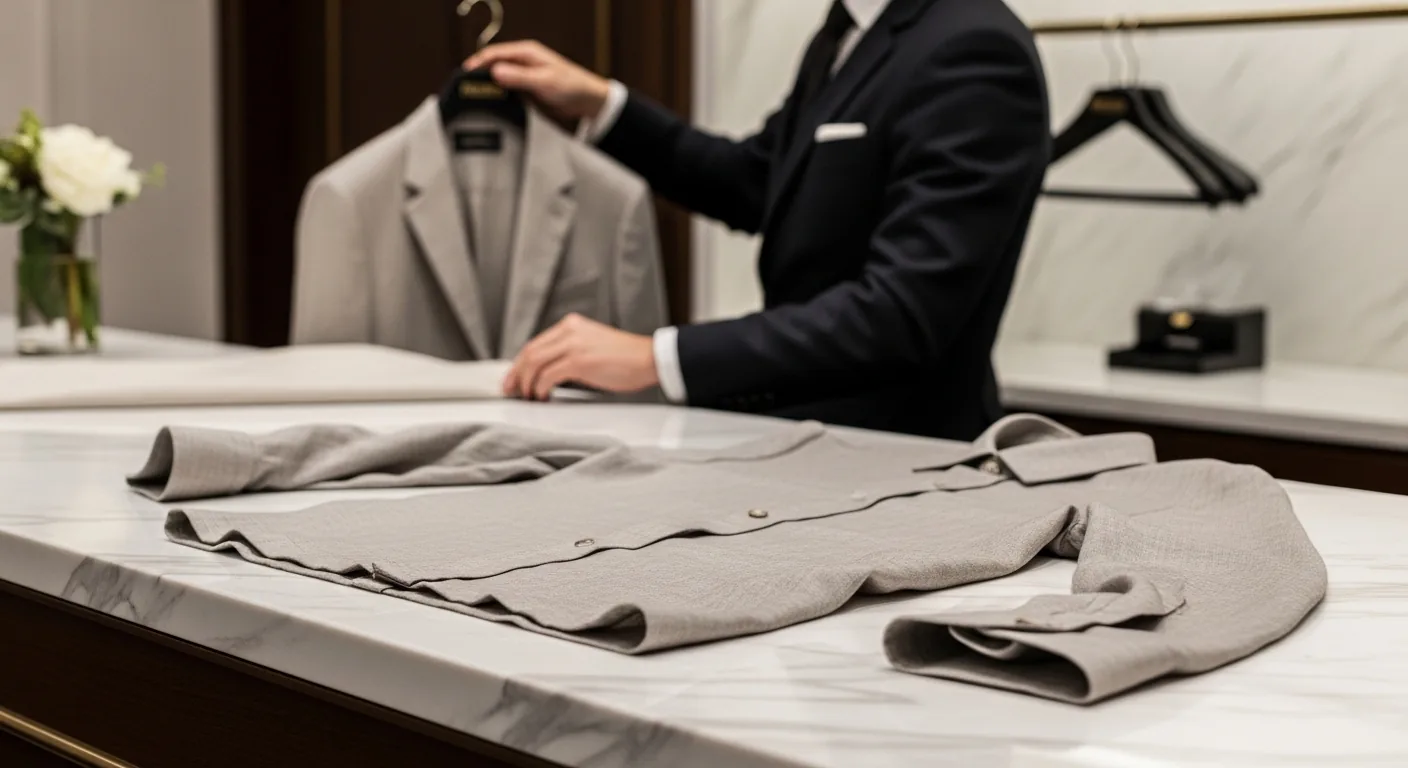
High-end linen garments are rarely simple. Luxury tailoring often includes:
Each layer reacts differently to moisture, heat, and tension. When internal and external components shrink or relax at different rates, garments develop bubbling, puckering, rippling seams, warped lapels, and loss of drape.
Standard cleaning does not account for these interactions. Specialist care evaluates layered behaviour before selecting treatment methods.
Why Pressing Is the Most Dangerous Stage
For linen, finishing is often riskier than cleaning itself. Linen responds strongly to heat and pressure, and excessive pressing compresses fibres and locks creases permanently into place.
Pressing-related damage includes:
Specialist finishing avoids flat pressing. Instead, controlled steam, shaping, tensioning, and gradual cooling allow fibres to stabilise naturally without thermal shock.
Inspection: The Foundation of Safe Linen Care
Before any cleaning begins, luxury linen garments undergo detailed inspection. Specialists assess:
This evaluation determines whether full cleaning, sectional treatment, or surface refreshing is safest. Without inspection, cleaners rely on assumptions — significantly increasing risk.
A piece worth protecting deserves a specialist.
Our Sydney couture and designer team handle it end-to-end — inspection, individual cleaning, hand-finishing, and door-to-door delivery.
Why Standard Cleaners Struggle With Linen
Most commercial dry cleaners are structured for speed and uniformity. Their systems are optimised for cotton, polyester, and wool blends — not fragile plant fibres like linen.
Typical practices include:
These methods are incompatible with linen’s structural limitations, leading to irreversible distortion when garments are processed in bulk environments.
The Long-Term Cost of Improper Linen Care
Damage to linen is often cumulative. Early signs may seem minor, such as faint water marks or slight seam irregularities. Over time, these issues develop into:
For bespoke or limited-edition pieces, this loss is particularly costly.
Why Specialists Treat Linen Conservatively
Luxury specialists approach linen with restraint rather than force. Their methods prioritise:
Rather than forcing linen into shape, fibres are guided back into alignment gradually. This conservative approach preserves natural character while maintaining structure.
The Luxe Dry Cleaners Linen Protocol
At Luxe Dry Cleaners Sydney, linen garments are treated as structured assets, not casual summer wear. Each piece is assessed individually for fabric weight, dye sensitivity, internal architecture, wear history, and intended use.
Our process prioritises longevity over speed, and preservation over convenience — which is why clients trust us with tailored linen worn for travel, business, and formal summer occasions.
Book Your Pickup
Luxury Dry Cleaning, Collected From Your Door
Complimentary collection and delivery across Sydney CBD, the Eastern Suburbs (Double Bay, Woollahra, Paddington, Bondi, Bellevue Hill, Darling Point) and the Lower North Shore (Mosman, Neutral Bay, Cremorne, Kirribilli). Every piece inspected and hand-finished by specialists.
Prefer to talk first? Speak with a specialist ›
Frequently Asked Questions
Because linen has low elasticity and reacts poorly to uncontrolled moisture and heat.
Sometimes, but prevention is far more reliable than correction.
Only with specialist controls and individual garment assessment.
Fibre movement under moisture and heat causes permanent contraction.
No. Flat pressing damages natural texture and structure.
Yes. They use finer fibres and more complex construction.
Specialist luxury garment cleaners with fabric-specific expertise.
Luxe Dry Cleaners is Sydney’s couture and luxury garment care specialist, servicing the CBD, Eastern Suburbs, and Lower North Shore with complimentary door-to-door collection and hand-finished quality. Further reading on fabric care: Woolmark care guidelines.